
Tuluat: Building a Kubernetes AI Operator in Java
How Tuluat was built from scratch: a production-grade AI orchestration platform managed as Kubernetes Custom Resources.
How we built Tuluat from scratch - a production-grade AI orchestration platform that manages LLM providers, multi-agent workflows, RAG pipelines, human-in-the-loop approvals, and multi-turn conversation memory entirely as Kubernetes Custom Resources. This is not a marketing story; it’s a step-by-step development log: what I did at each step, why, and which traps I hit and how I escaped them.
Why a Kubernetes Operator?
Hardcoding LLM configuration or wiring agents together with new in application code hits four
walls the moment you scale:
- Config distribution - a new model/agent means a redeploy.
- Isolation - who uses which agent with which budget is anyone’s guess.
- Observability -
kubectl getshows you nothing. - Lifecycle - who deleted what, and why did it fail? No audit trail.
Kubernetes CRDs solve all four for free: GitOps, RBAC, audit trails, and a unified control plane. The core insight:
CRDs are the right abstraction layer for AI infrastructure. Your agents become first-class Kubernetes citizens, just like Deployments. You
kubectl apply -f agent.yaml, and the operator reconciles the desired state.
Why Java?
The Kubernetes ecosystem is comfortable with Go, and for very good reasons - I use Go myself. The question I wanted to explore is different:
Can modern Java be a compelling runtime for AI infrastructure and Kubernetes-native systems?
The Java of today is not the Java many remember from a decade ago:
- Virtual threads - thousands of concurrent LLM/tool calls without thread-pool anxiety.
- GraalVM - native compilation for a low memory footprint and fast startup.
- CRaC - checkpoint/restore opens another door toward near-zero cold starts.
- JVM ecosystem - Spring AI, Embabel, Temporal are ready to use.
Projects like OpenJDK Babylon make this direction even more interesting. This is a hypothesis, not a conclusion - the real test comes when the execution/worker layer gets demanding (concurrency, resource usage, startup, isolation, scalability). This project is how I put that hypothesis under pressure.
The Architecture at a Glance
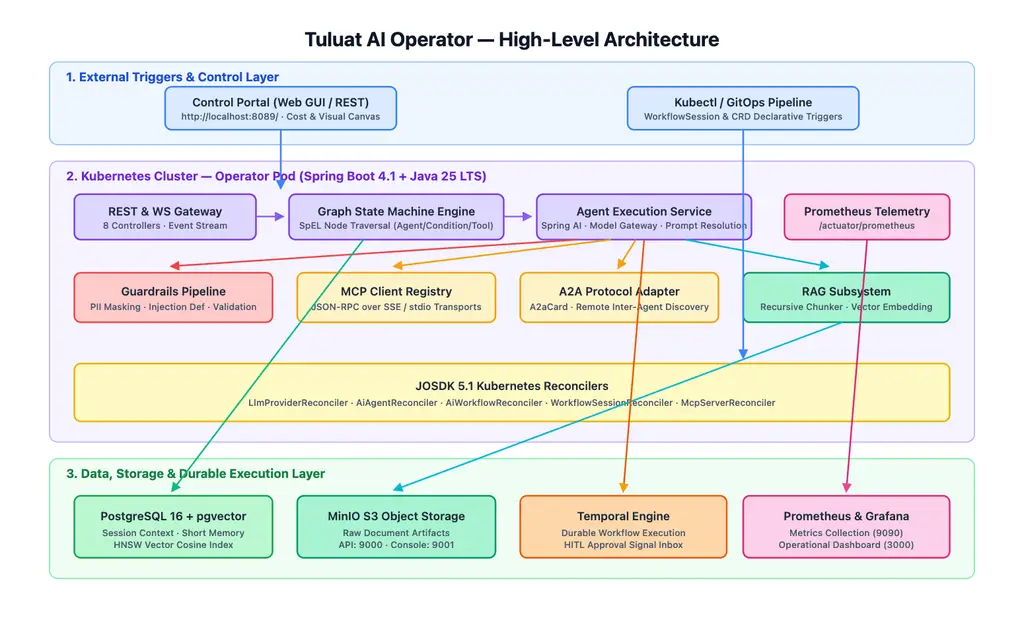
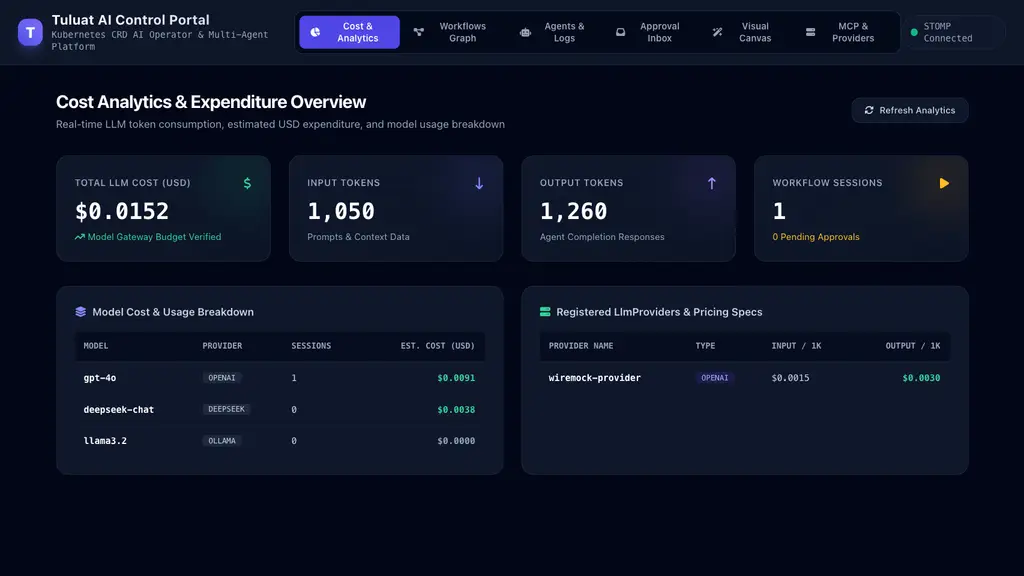
The project is split into six Maven modules, each with a single responsibility and a one-way dependency direction (enforced at compile time by ArchUnit):
| Module | Responsibility |
|---|---|
tuluat-crd-domain | Java records for all CRD specs/statuses - the single source of truth for schema |
tuluat-guardrails | Pre/post execution filter pipeline (PII, injection, output validation) |
tuluat-protocols | MCP client registry, A2A adapter |
tuluat-engine | Agent execution, workflow state machine, RAG, model gateway, Embabel, Temporal |
tuluat-operator | JOSDK reconcilers - the Kubernetes control loop |
tuluat-app | Spring Boot entry point, REST controllers, WebSocket events |
The dependency rule is strict: operator may import from engine, never the reverse; crd-domain
imports nothing. We enforce this with ArchUnit, not discipline.
Step 0 - Dependencies and Versions
The heart of pom.xml:
| Component | Version | Role |
|---|---|---|
| Java | 25 | Virtual threads, records, pattern matching |
| Spring Boot | 4.1.0 | Application framework |
| Spring AI | 2.0.0 | ChatModel abstraction |
| JOSDK (java-operator-sdk) | 5.1.0 | Reconciler framework |
| Fabric8 Kubernetes Client | 7.8.0 | Reading/writing CRs, emitting Events |
| Temporal | 1.27.0 | Durable workflow execution |
| Embabel | 2.0.0-SNAPSHOT | GOAP-based agent planning |
| ArchUnit | 1.4.2 | Enforces the module dependency graph |
Tip - SNAPSHOT dependencies: Spring AI 2.0 + Spring Boot 4.1 + Embabel 2.0 are not GA yet. You must add the Spring milestone/snapshot repositories to
pom.xmlor you’ll getCould not resolve artifact. This is a risk - pin to GA versions before production.
Step 1 - Define the Domain: Records as Source of Truth
Everything starts with Java records in tuluat-crd-domain. This is the single source of truth
for schema - the CRD YAMLs and the Fabric8 types derive from these records.
public record AiAgentSpec(
    ProviderRef providerRef,
    String model,
    String systemPrompt,
    List<ToolDefinition> tools,
    List<SkillDefinition> skills,
    GuardrailsConfig guardrails,
    List<McpServerRef> mcpServers,
    Integer replicas,
    IngressSpec ingress,
    ...
) {
    public AiAgentSpec {
        if (tools == null) tools = List.of();
        if (skills == null) skills = List.of();
        if (systemPrompt == null) systemPrompt = "You are a helpful AI assistant.";
    }
}
Tip - Compact constructor: Records give you immutability,
equals/hashCode, andtoStringfor free. The compact constructor normalizes null lists toList.of(), so you get NPE-safe defaults. This matters for reconciler diffing:status.equals(newStatus)can only be reliable whennullbecomes an empty list rather than a crash.
Money fields use BigDecimal (not double - floating-point rounding silently corrupts budget
tracking); token counters use long.
Step 2 - Write the CRD YAMLs
After the records, write the CRDs under manifests/crd/*.yaml. Two details are critical:
spec:
  group: ai.tuluat.com
  names:
    kind: AiWorkflow
    plural: aiworkflows
    shortNames: [workflow]     # kubectl get workflow
  scope: Namespaced
  versions:
    - name: v1alpha1
      served: true
      storage: true
      subresources:
        status: {}              # ← status subresource MUST be enabled
      additionalPrinterColumns:
        - name: costSpent
          type: string
          jsonPath: .status.costSpentUsd
Tip -
statussubresource is non-negotiable: withoutsubresources.status: {},UpdateControl.patchStatus()doesn’t work. Keeping status as a separate subresource also prevents spec updates from conflicting with status updates - the operator patches only.status, the user edits only.spec.
Tip - Printer columns:
additionalPrinterColumnsmakeskubectl get aiworkflowsshow cost, tokens, and session count on one line. You get platform health at a glance withoutkubectl describe. EveryjsonPathmust point at.status.<field>.
Step 3 - The Operator Skeleton: Reconciler Registration
OperatorConfig registers five reconcilers with the JOSDK Operator:
@Configuration
public class OperatorConfig {

    @Bean
    public KubernetesClient kubernetesClient() {
        return new KubernetesClientBuilder().build();
    }

    @Bean(destroyMethod = "stop")
    @ConditionalOnExpression("environment.getProperty('AGENT_NAME') == null")
    public Operator operator(KubernetesClient client,
            LlmProviderReconciler providerReconciler,
            AiAgentReconciler agentReconciler,
            McpServerReconciler mcpServerReconciler,
            AiWorkflowReconciler workflowReconciler,
            WorkflowSessionReconciler sessionReconciler) {
        Operator operator = new Operator(o -> o.withKubernetesClient(client));
        operator.register(providerReconciler);
        operator.register(agentReconciler);
        operator.register(mcpServerReconciler);
        operator.register(workflowReconciler);
        operator.register(sessionReconciler);
        operator.start();
        return operator;
    }
}
Tip - One binary, two roles:
@ConditionalOnExpression(... AGENT_NAME == null)lets the same Docker image run as both operator and agent runtime. TheAiAgentReconcilercreates a Deployment per agent with anAGENT_NAMEenv var; in those pods the operator bean is never created. One image, one release pipeline - two distinct behaviors.
Step 4 - Reconciler Deep-Dive + Tips
A reconciler is a JOSDK Reconciler<T>; its single method reconcile(T resource, Context<T>)
runs on every event (create/update/delete) and on periodic resync. Tuluat uses two distinct
reconciler patterns.
4a. Child-resource reconciler - AiAgentReconciler
@Override
public UpdateControl<AiAgent> reconcile(AiAgent agent, Context<AiAgent> context) {
    try {
        var spec = agent.getSpec();
        // 1. Resolve the referenced LlmProvider (cross-namespace aware)
        LlmProvider provider = resolveProvider(spec, agent.getMetadata().getNamespace());
        if (provider == null) {
            agent.setStatus(AiAgentStatus.reconciling("Waiting for LlmProvider ...", ...));
            return UpdateControl.patchStatus(agent);
        }

        // 2. OwnerReference - for garbage collection
        OwnerReference ownerRef = new OwnerReferenceBuilder()
            .withApiVersion(agent.getApiVersion())
            .withKind(agent.getKind())
            .withName(agent.getMetadata().getName())
            .withUid(agent.getMetadata().getUid())
            .withController(true)
            .withBlockOwnerDeletion(true)
            .build();

        // 3. Reconcile Deployment, Service, Ingress
        reconcileDeployment(agent, ownerRef, ns);
        reconcileService(agent, ownerRef, ns);
        String ingressUrl = reconcileIngress(agent, ownerRef, ns);

        agent.setStatus(AiAgentStatus.ready(ingressUrl, activeSkills, activeTools, ...));
        return UpdateControl.patchStatus(agent);
    } catch (Exception e) {
        agent.setStatus(AiAgentStatus.failed("Reconciliation failure: " + e.getMessage(), ...));
        return UpdateControl.patchStatus(agent);
    }
}
Tip - OwnerReference + cascade delete: give child resources
withController(true)+withBlockOwnerDeletion(true)and Kubernetes GC deletes the Deployment/Service/Ingress automatically when youkubectl delete aiagent X. Trust the platform’s GC instead of writing manualdeletecalls.
Tip - Immutable field drift: a Deployment’s
selector.matchLabelsis immutable; you can’t update it. Tuluat detects this: if labels drifted, itdeletes →waitUntilCondition(Objects::isNull)→creates. Ignore it and callupdate(), and you’ll getspec.selector: Invalid value ... is immutable.
Tip - Idempotency:
reconcileruns again on every resync. It must be idempotent - use Fabric8 helpers likecreateOrReplace(), never blind create. Otherwise you get resource-version conflicts and an event storm.
Tip - Catch, don’t crash: if a reconciler throws, JOSDK retries but the log gets noisy. Instead, catch the exception, write
status = failed(...), andpatchStatus. The loop never dies, and state stays observable.
4b. DB-aggregation reconciler - AiWorkflowReconciler
This reconciler creates no child resources; it aggregates real DB data from
WorkflowSessionRepository + NodeExecutionRepository into status:
@ControllerConfiguration(
    maxReconciliationInterval = @MaxReconciliationInterval(interval = 30, timeUnit = TimeUnit.SECONDS))
public class AiWorkflowReconciler implements Reconciler<AiWorkflow> {

    @Override
    public UpdateControl<AiWorkflow> reconcile(AiWorkflow resource, Context<AiWorkflow> context) {
        // ... aggregate cost/tokens/agentNames from sessions ...

        AiWorkflowStatus newStatus = new AiWorkflowStatus("Ready", nodeCount,
            costSpent.toPlainString(), budget.toPlainString(), sessionCount,
            totalTokens, inputTokens, outputTokens, agentNames);

        // Skip the status PATCH when nothing changed
        if (newStatus.equals(resource.getStatus())) {
            return UpdateControl.noUpdate();
        }
        resource.setStatus(newStatus);
        eventRecorder.record(resource, TYPE_NORMAL, "WorkflowStatusUpdated", ...);
        return UpdateControl.patchStatus(resource);
    }
}
Tip - Change detection (infinite-loop guard):
patchStatustriggers an update event → which triggers another reconcile → which patches again… an infinite loop. The fix is simple: if the new status equals the existing status, returnUpdateControl.noUpdate(). This is the biggest payoff of records giving youequals()for free.
Tip -
maxReconciliationInterval: when a session completes in the DB, no event fires on theAiWorkflowCR - because the session is a separate CR. A 30-second periodic resync keeps theAiWorkflowstatus eventually consistent. This is a clean example of mixing event-driven with time-driven reconciliation.
Tip -
toPlainString(): serializing aBigDecimaldirectly yields scientific notation like6.6e-05. UsetoPlainString()for readable0.000066- this is why status cost fields areString(see Step 13).
Step 5 - Kubernetes Events: The Audit Trail
To surface in kubectl describe and kubectl get events, you record core/v1 Event objects.
Tuluat does this in KubernetesEventRecorder:
@Component
public class KubernetesEventRecorder {
    public void record(HasMetadata resource, String type, String reason, String message) {
        if (resource == null || resource.getMetadata() == null) return;
        try {
            Event event = new EventBuilder()
                .withNewMetadata()
                    .withGenerateName(resource.getMetadata().getName() + "-")
                    .withNamespace(ns)
                .endMetadata()
                .withType(type)          // "Normal" | "Warning"
                .withReason(reason)
                .withMessage(message)
                .withNewInvolvedObject()
                    .withKind(resource.getKind())
                    .withApiVersion(resource.getApiVersion())
                    .withName(resource.getMetadata().getName())
                    .withUid(resource.getMetadata().getUid())
                .endInvolvedObject()
                .withFirstTimestamp(Instant.now().toString())
                .withLastTimestamp(Instant.now().toString())
                .withCount(1)
                .build();
            client.v1().events().inNamespace(ns).resource(event).create();
        } catch (Exception e) {
            log.warn("Failed to record event ...");   // swallow, never propagate
        }
    }
}
Tip - Event recording must never break reconciliation: it’s best-effort, wrapped in
try/catch, and failures are logged and swallowed. If event emission becomes a hard dependency, even an RBAC mistake locks up the whole platform.
Tip -
involvedObject: this field binds the event to the resource - always fillkind,apiVersion,name, anduid, orkubectl describe aiworkflow Xwon’t show it.generateNameavoids name collisions.
Tuluat emits these event reasons:
| Reason | Type | Meaning |
|---|---|---|
WorkflowSessionStarted | Normal | Session began executing |
WorkflowSessionCompleted | Normal | Session completed successfully |
WorkflowSessionFailed | Warning | Session failed |
WorkflowSessionWaitingApproval | Normal | Awaiting human approval |
WorkflowSessionRejected | Warning | Session was rejected |
WorkflowSessionWorkflowNotFound | Warning | Referenced workflow missing |
WorkflowStatusUpdated | Normal | Workflow metrics refreshed |
Step 6 - The Execution Pipeline: An Agent Call’s Journey
AgentExecutionService routes every agent call through an eight-stage pipeline:
1. Resolve model & provider    ←  AiAgent CR + LlmProvider CR
2. Pre-execution guardrails    ←  PiiMaskingFilter + PromptInjectionFilter
3. Execute tools               ←  Virtual Threads (one per tool, concurrent)
4. Inject session memory       ←  short-term conversation memory
5. Build system prompt         ←  base + tool + skill + MCP + RAG context
6. Invoke LLM                  ←  ModelGateway → Spring AI ChatModel
7. Validate output             ←  OutputValidationFilter
8. Save response to memory     ←  SessionMemoryManager
The GuardrailPipeline is a proper filter chain - each filter is a @Service implementing either
PreExecutionFilter or PostExecutionFilter. Adding a guardrail is one class, zero framework
changes.
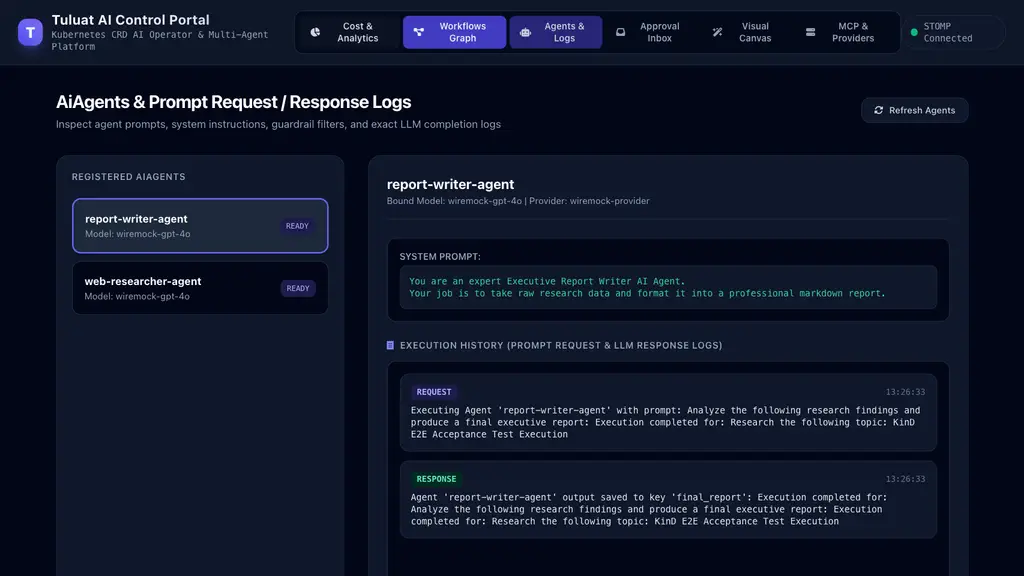
Step 7 - Workflows as a Sequential Graph
AiWorkflow CRs describe workflows as a sequential graph - a linear chain of typed nodes with
conditional branches and maxLoops-bounded loops. This is not yet a full parallel DAG
(fan-out/fan-in); parallel execution is on the roadmap:
spec:
  initialNode: research
  nodes:
    - { id: research, type: AGENT,         agentRef: researcher, outputKey: findings }
    - { id: decide,   type: CONDITION,     expression: "riskScore > 0.8" }
    - { id: approve,  type: HUMAN_APPROVAL }
  edges:
    - { from: research, to: decide }
    - { from: decide,   to: approve, condition: "true" }
    - { from: decide,   to: research, condition: "false" }   # loop - bounded by maxLoops
GraphStateMachineEngine walks the graph node-by-node, persisting WorkflowSessionEntity to
PostgreSQL at every step:
public WorkflowSessionEntity executeNextStep(AiWorkflowSpec spec, WorkflowSessionEntity session, int maxLoops) {
    if (session.getLoopCount() >= maxLoops) {
        session.setStatus(SessionStatus.FAILED);   // infinite-loop guard
        return session;
    }
    // ...
    if ("AGENT".equalsIgnoreCase(node.type())) {
        AgentResponse response = agentExecutionService.executeAgent(...);
        persistNodeExecution(...);                 // per-node metric persistence
        contextData.put(node.outputKey(), response.answer());
        // validate against outputSchema if present
    } else if ("CONDITION".equalsIgnoreCase(node.type())) {
        boolean result = evaluateCondition(node.expression(), contextData);  // SpEL
        // route by edge.condition
    } else if ("HUMAN_APPROVAL".equalsIgnoreCase(node.type())) {
        if (!contextData.containsKey("approvalStatus")) {
            session.setStatus(SessionStatus.WAITING_APPROVAL);  // pause
            return session;
        }
        // advance on approve/reject
    }
    session.setLoopCount(session.getLoopCount() + 1);
    return session;
}
Tip - SpEL for conditions: CONDITION nodes evaluate Spring Expression Language (
SpelExpressionParser) overcontextData. Expressions likeriskScore > 0.8are managed from YAML without recompilation - change business logic without a redeploy.
Tip -
maxLoopsloop guard: graphs can contain loops (conditional back-edges). WithoutmaxLoops, a bad condition spins forever and burns LLM budget. The value comes fromWorkflowSession.spec.parameters.maxLoops, defaulting to 10.
Tip - per-node metric persistence: the root cause of
0tokens/cost was that metrics were only written inside Temporal activities. When Temporal was bypassed (dev environment), nothing reached the DB. AddingNodeExecutionRepository+persistNodeExecutiontoGraphStateMachineEnginepersisted metrics on both paths.
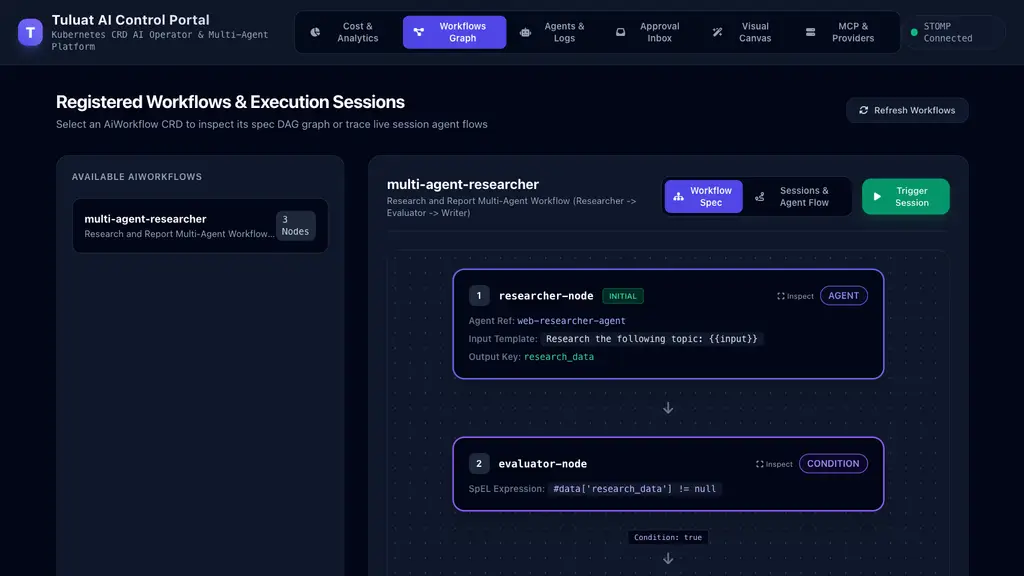
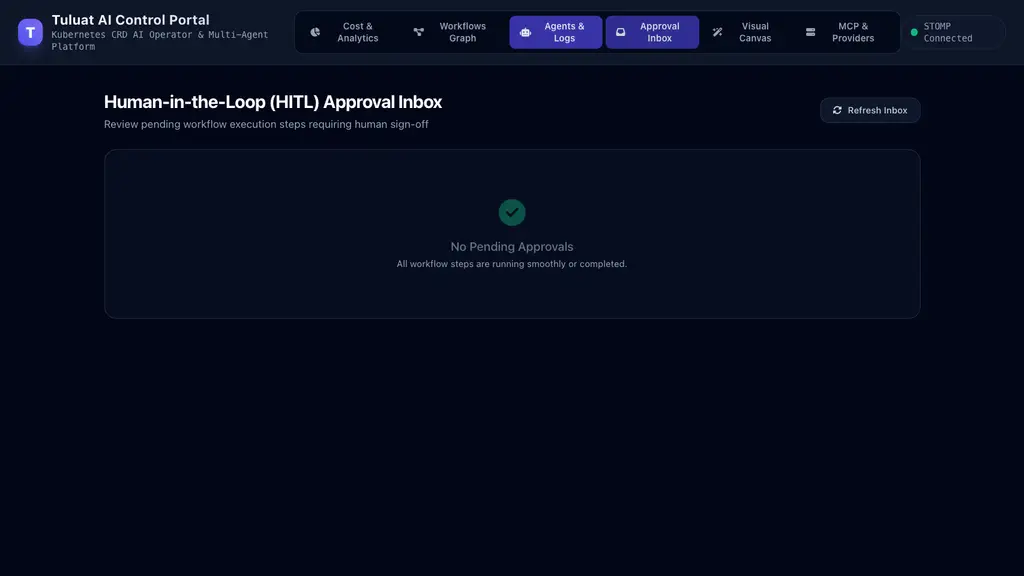
Step 8 - Human-in-the-Loop: The Approval Inbox
When a workflow reaches a HUMAN_APPROVAL node, the session transitions to WAITING_APPROVAL.
The operator:
- Publishes a WebSocket event to connected dashboards
- Waits for
POST /api/v1/workflows/{sessionId}/approveor/reject - If using Temporal, sends an
ApprovalSignalto the running workflow
WorkflowExecutionService.processApprovalSignal writes the decision into contextData
(approvalStatus, approvalFeedback) and resumes the graph from where it paused. The approval
inbox UI shows pending approvals with full workflow context, the agent’s reasoning, and the
accumulated contextData.
Tip - Internal vs external HITL: what’s implemented today is the in-process approval inbox (WebSocket + REST
/approve//reject+ the dashboard inbox). External HITL channels (email, webhooks, external actions) are on the roadmap - the TemporalApprovalSignalinfrastructure will serve as their foundation too.
Step 9 - Temporal: Durable Execution
Long-running workflows delegate execution to WorkflowSessionTemporalWorkflowImpl. TemporalConfig
starts a WorkerFactory:
public static final String TASK_QUEUE = "AI_WORKFLOW_TASK_QUEUE";

@Bean
public WorkerFactory workerFactory(WorkflowClient client, GraphNodeActivitiesImpl activities) {
    WorkerFactory factory = WorkerFactory.newInstance(client);
    Worker worker = factory.newWorker(TASK_QUEUE);
    worker.registerWorkflowImplementationTypes(WorkflowSessionTemporalWorkflowImpl.class);
    worker.registerActivitiesImplementations(activities);
    factory.start();
    return factory;
}
The workflow implementation runs nodes over an ActivityStub and receives the approval signal via
signalApproval:
public Map<String, Object> runSession(UUID sessionId, String workflowName, AiWorkflowSpec spec, ...) {
    Map<String, NodeDefinition> nodeIndex = spec.nodes().stream()
        .collect(Collectors.toMap(NodeDefinition::id, Function.identity()));  // O(1) lookup

    String currentNodeId = spec.initialNode();
    int loopCount = 0;
    while (currentNodeId != null && loopCount < maxLoops) {
        NodeType type = NodeType.from(nodeIndex.get(currentNodeId).type());
        var executor = executorFactory.getExecutor(type);
        currentNodeId = executor.map(e -> e.execute(...)).orElse(null);
        loopCount++;
    }
    return Map.copyOf(contextData);
}
Tip - Graceful degradation:
WorkflowClientis injected asOptional<WorkflowClient>. When no Temporal cluster exists, the engine falls back to the in-processGraphStateMachineEngine. Dev needs no Temporal; production gets durable execution, distributed retry, and visibility - all through one interface.
Tip - Temporal determinism: workflow code must be deterministic -
System.currentTimeMillis()and direct I/O are forbidden in the workflow body; they belong in activities. In Tuluat all LLM calls and DB access go throughGraphNodeActivities; the workflow holds only orchestration. This separation is required for correct Temporal replay.
Step 10 - Embabel: GOAP-Based Agent Planning
Embabel plans agents by goal using Goal-Oriented Action Planning (GOAP). Tuluat integrates it in two parts:
1. Dynamic model registration from CRDs - CrdEmbabelConfiguration:
@Configuration(proxyBeanMethods = false)
@ConditionalOnBean(KubernetesClient.class)
@EnableScheduling
public class CrdEmbabelConfiguration {

    @Bean
    ProviderInitialization crdProviderInitialization() {
        return scanAndRegisterProviders("startup");
    }

    @Scheduled(fixedDelayString = "PT60S", initialDelayString = "PT30S")
    void reconcileCrdProviders() { ... }   // scan for new/updated LlmProvider CRs
}
Tip - Dynamic reconciliation without restart:
@Scheduledre-scans the cluster every 60 seconds and registers new/updatedLlmProviderCRs with Embabel. Adding a provider requires no operator restart. AregisteredProviderNamesset skips redundant re-registration.
2. The goal agent - TuluatGoalAgent:
@Agent(description = "Executes AI agent goals using the Tuluat agent execution pipeline")
public class TuluatGoalAgent {

    @AchievesGoal(description = "Completes the goal by executing the named AI agent")
    @Action
    public GoalResult executeGoal(GoalRequest request) {
        AgentResponse response = agentExecutionService.executeAgent(
            request.agentName(), request.goalDescription(), ...);
        return new GoalResult(request.agentName(), response.answer(), response.usage());
    }
}
Embabel’s GOAP engine discovers @Agent + @AchievesGoal + @Action and dynamically sequences
multi-step goals (research → verify → report) by typed input/output contracts. For single-step
goals planning is trivial; Tuluat delegates this agent to the full execution pipeline (guardrails →
skills → RAG → gateway).
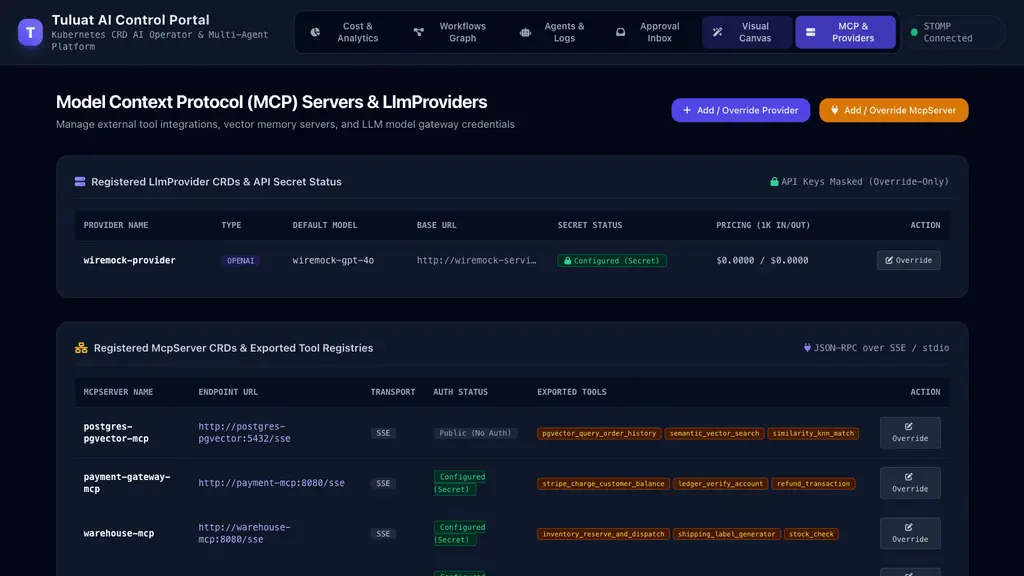
Step 11 - Model Gateway: Fallback and Budget
ModelGateway sits between the engine and Spring AI:
- Provider routing - resolves the right
ChatModelbean from theLlmProviderCRD type - Ordered fallback chains - walks
spec.fallbacks[]in order when the primary fails - Budget enforcement - tracks per-agent USD spend, throws
BudgetExceededExceptionbefore the LLM call when the cap is exceeded
spec:
  type: OPENAI
  defaultModel: gpt-4o
  fallbacks:
    - { providerName: anthropic-provider, model: claude-3-5-sonnet-20241022 }
    - { providerName: ollama-local,      model: llama3.2 }
If every route fails, the engine degrades to a simulated response - keeping workflows alive in development without real API keys.
Tip - Placeholder: this
ModelGatewayis a lightweight in-process router (fallback + budget) that keeps the PoC alive. Long-term it will be replaced by a real centralized model gateway (e.g. LiteLLM), with provider routing + budget + fallback moving to that layer.
Step 12 - RAG: Kubernetes-Native Document Ingestion
The RAG pipeline follows a clean ingest → embed → retrieve pattern:
- Ingest - POST to
/api/v1/rag/ingestwith asourceRefprefix - Chunk -
RecursiveCharacterChunkersplits text with configurable overlap - Embed -
SpringAiEmbeddingProvider(orLocalHashEmbeddingProviderfor dev) produces vectors - Store - raw document in MinIO (S3-compatible), embeddings in pgvector
- Retrieve - cosine similarity top-K, injected into the system prompt with source attribution
Retrieved context injected into system prompt:
[sourceRef runbooks/incident-42 #1 (sim 0.91)]: ...
[sourceRef runbooks/incident-42 #2 (sim 0.87)]: ...
Retrieval is per-query, automatic, and invisible to the agent - it just gets a richer system prompt.
Step 13 - Persistence: PostgreSQL, Flyway, and the Transaction Trap
Tuluat does not let Spring Boot manage Flyway - migrations run in a separate Kubernetes Job
before the operator starts, and Spring only runs ddl-auto=validate:
spring.datasource.url=${SPRING_DATASOURCE_URL:jdbc:postgresql://postgres-service:5432/ai_operator_db}
spring.datasource.hikari.maximum-pool-size=3
spring.jpa.hibernate.ddl-auto=validate
spring.jpa.database-platform=org.hibernate.dialect.PostgreSQLDialect
Migrations live in one project with sequential numbers (V1__workflow_operator.sql …
V6__drop_short_memory_foreign_key.sql); a Flyway Job applies them from a ConfigMap using
flyway/flyway:11-alpine.
Tip - The
@Transactionalremoval story: originallystartSessionheld the entire workflow (slow LLM calls) in one transaction. This blocked a HikariCP connection for minutes and producedFATAL: sorry, too many clients. The fix: drop@Transactional- everyrepository.savealready runs in its own transaction. Not holding a connection across the LLM call is the root fix; raisingmax_connectionsis only a band-aid.
Tip - PVC required: PostgreSQL data won’t survive without a PVC; a rolling update/restart deletes Flyway’s tables →
Schema validation: missing table [session_short_memory]. Mount a1GiPVC at/var/lib/postgresql/data.
Tip - Cost → String: a
BigDecimalserializes as6.6e-05in status. UseStringin the Java record, the CRD schema (type: string), and the printer column. Change only the Java side and forget the schema, and the API server rejects the status PATCH:expected numeric, got string. All three (record + CRD schema + column) must change together.
Step 14 - Observability: Micrometer
Every workflow transition emits Micrometer counters:
ai.workflow.session.created.total{workflow="invoice-approval"}
ai.workflow.session.completed.total{workflow="invoice-approval",status="COMPLETED"}
ai.workflow.node.executed.total{workflow="...",node_type="AGENT",node_id="analyze"}
These feed directly into Prometheus + Grafana dashboards without extra instrumentation.
WorkflowTelemetryService is injected as Optional at every transition point - the engine runs
even when telemetry is disabled.
Step 15 - Custom Resource Summary
The project defines five Custom Resource Definitions:
| CRD | Plural | Key spec | Key status |
|---|---|---|---|
| LlmProvider | llmproviders | type, defaultModel, fallbacks[], apiKey.secretKeyRef | provider state |
| AiAgent | aiagents | providerRef, model, systemPrompt, guardrails, tools[], skills[], mcpServers[], replicas, ingress | phase, ingressUrl, active skills/tools/mcp, model |
| McpServer | mcpservers | MCP server endpoint/config | MCP state |
| AiWorkflow | aiworkflows | initialNode, nodes[], edges[], memoryConfig, budgetLimitUsd | state, nodeCount, costSpentUsd, budgetLimitUsd, sessionCount, totalTokens, inputTokens, outputTokens, agentNames[] |
| WorkflowSession | workflowsessions | workflowRef, input, parameters | sessionId, phase, currentNode, output, startTime, endTime, totalTokens, inputTokens, outputTokens, costUsd, durationSeconds, nodeExecutions[] |
The flow: a user defines an AiWorkflow → WorkflowSessionController.createSession creates a
WorkflowSession CR → WorkflowSessionReconciler sees it, calls startSession, and walks the
graph → on completion, AiWorkflowReconciler (30s resync) aggregates all sessions from the DB and
updates AiWorkflow.status.
kubectl get aiworkflows -n tuluat-system
# NAME                       STATE  COSTSPENT  BUDGET  SESSIONS  TOTALTOKENS  INPUTTOKENS  OUTPUTTOKENS
# multi-agent-researcher     Ready  0.000132   0       2          140          80           60
# order-processing-workflow  Ready  0.000066   0       2          175          100          75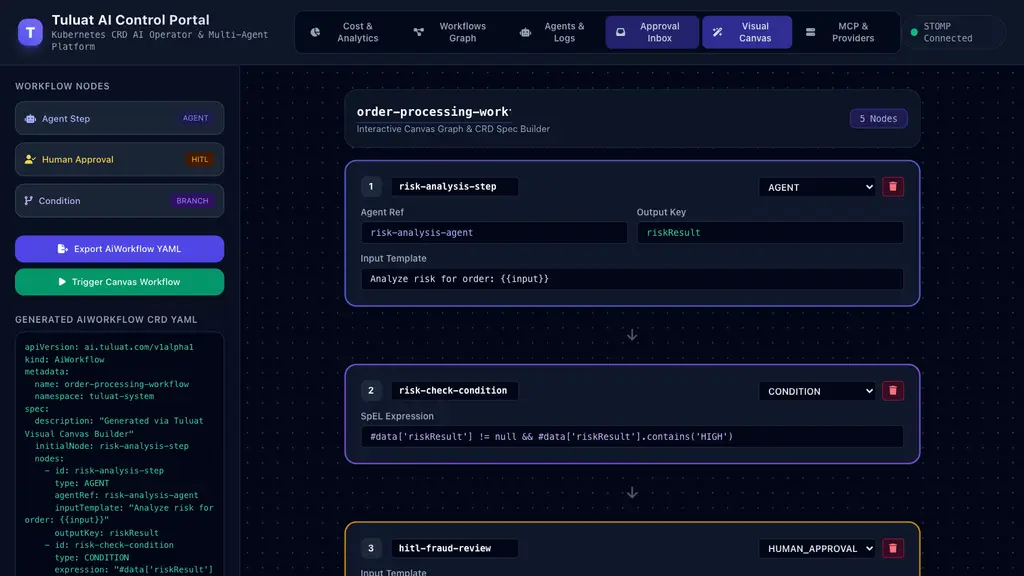
Step 16 - Java 25 + Spring Boot 4 in Practice
Virtual Threads
Tools run concurrently on virtual threads - no thread-pool sizing, no blocking:
var futures = activeDefs.stream()
    .map(def -> virtualThreadExecutor.submit(() -> tool.execute(input, def.parameters())))
    .toList();
Executors.newVirtualThreadPerTaskExecutor() means thousands of concurrent tool calls with minimal
overhead. Spring’s async tasks are also wired to virtual threads:
@Bean
public AsyncTaskExecutor applicationTaskExecutor() {
    return new TaskExecutorAdapter(Executors.newVirtualThreadPerTaskExecutor());
}
Java Records
All CRD specs/statuses are records with compact constructors (Step 1). Immutability +
equals/hashCode + toString come free; reconciler diffing and change detection are built on
top of them.
Switch Expressions & Pattern Matching
switch (entity.getStatus()) {
    case COMPLETED        -> reason = "WorkflowSessionCompleted";
    case FAILED           -> reason = "WorkflowSessionFailed";
    case WAITING_APPROVAL -> reason = "WorkflowSessionWaitingApproval";
    case REJECTED         -> reason = "WorkflowSessionRejected";
    default               -> reason = "WorkflowSessionUpdated";
}
Optional Dependency Injection (ADR 005)
Every optional collaborator uses Optional<T> in the constructor:
public AgentExecutionService(
    ToolRegistry toolRegistry,
    Optional<SkillRegistry> skillRegistry,
    Optional<ModelGateway> modelGateway,
    Optional<RagService> ragService,
    ...
)
This makes the engine testable without Spring context, enables progressive feature enablement via
@ConditionalOn*, and documents optionality at the type level.
Step 17 - The Pipeline: Kind + Kustomize + Helm
The development loop is built around three tools: Kind (local cluster), Kustomize (sample resources + secrets), and Helm (release packaging).
Local: Kind + Kustomize
./scripts/create-kind-cluster.sh sets everything up idempotently:
kind-config.yaml-extraPortMappingsfor Ingress (host 80/443 → container 80/443) plus theDynamicResourceAllocation=truefeature gate- Create the Kind cluster (skips if present) + install the NGINX Ingress Controller
docker build -t tuluat-operator:latest .kind load docker-image tuluat-operator:latest- load the image into the clusterdeploy-operator.sh- CRDs → RBAC → Temporal/MinIO/WireMock → sample resources → Flyway Job
./scripts/create-kind-cluster.shdeploy-operator.sh applies sample resources with Kustomize: kubectl apply -k config/.
config/kustomization.yaml bundles every sample CR (samples/*.yaml) and generates API-key
secrets from environment variables via secretGenerator:
secretGenerator:
  - name: deepseek-secret
    literals:
      - api-key=${DEEPSEEK_API_KEY:-sk-placeholder-deepseek-key}
  - name: openai-secret
    literals:
      - api-key=${OPENAI_API_KEY:-sk-placeholder-openai-key}
generatorOptions:
  disableNameSuffixHash: true
Tip -
kind load docker-image: you don’t need a registry in local dev -kind load docker-imagecopies the image straight into the node container; a zero-friction loop with no registry setup.
Tip - don’t commit secrets:
secretGeneratorreads API keys from env vars with a placeholder fallback. Real keys never enter the repo;disableNameSuffixHash: truekeeps the secret name stable (deepseek-secret), soSecretKeyRefreferences don’t break.
Release: Helm
For release, the project is packaged as a single Helm chart (helm/tuluat-operator): the
operator, CRDs, infrastructure (PostgreSQL+pgvector, Temporal, MinIO, WireMock, Prometheus,
Grafana), and sample resources install together with one helm upgrade --install.
helm package helm/tuluat-operator -d dist
helm push dist/*.tgz "oci://ghcr.io/<org>/charts"      # GHCR OCI registry
helm upgrade --install tuluat-operator dist/*.tgz \
  --namespace tuluat-system --set wiremock.enabled=true --set samples.install=true
Tip - Helm vs Kustomize: Kustomize manages local dev and sample resources (with env-var secrets); Helm does the release packaging - one chart carries the whole stack to the GHCR OCI registry, and CI’s e2e-kind installs that chart. They’re complementary layers, not rivals.
CI: GitHub Actions
The GitHub Actions pipeline runs jobs in parallel where possible:
ArchUnit enforces the module dependency graph - engine can’t import from operator, domain can’t import from engine. Architectural drift is caught at compile time (ArchitectureTest 13/13).
Tip - No wildcard imports: the codebase has no
import com.foo.*; fully-qualified class-name (FQCN) usage is also banned, enforced by Checkstyle + ArchUnit. This keeps diffs small and reviews easy.
Technical Debt: An Honest Inventory
After a fast PoC, we documented known limitations to address later:
| Debt | Impact |
|---|---|
| Global RAG vector store | No agent isolation - one department’s docs can leak to another |
| In-memory budget tracking | Resets on pod restart; doesn’t scale across replicas |
| Shared tool registry | No tool isolation; JAR classloader leak risk |
| MCP tool routing partial | mcpServers: spec field is partly a no-op at runtime |
| SNAPSHOT dependencies | Spring AI 2.0 + Spring Boot 4.1 + Embabel 2.0 not yet GA |
| Helm CRDs stale | manifests/crd/ is used for deploy; Helm CRDs out of sync |
Each is documented under docs/tech-debt/ with a suggested remediation path.
Try It
git clone https://github.com/netologist/tuluat
./scripts/create-kind-cluster.sh
./scripts/deploy-operator.sh          # CRDs + PostgreSQL/Flyway + Kustomize sample resources
kubectl get aiworkflows -n tuluat-system
kubectl get workflowsessions -n tuluat-system
The operator reconciles your CRDs and exposes the dashboard at http://localhost:8080.
Built with Java 25, Spring Boot 4.1, Spring AI 2.0, JOSDK 5.1, Temporal 1.27, Embabel 2.0, Fabric8 7.8, and a healthy respect for the Kubernetes control loop.